
Overview
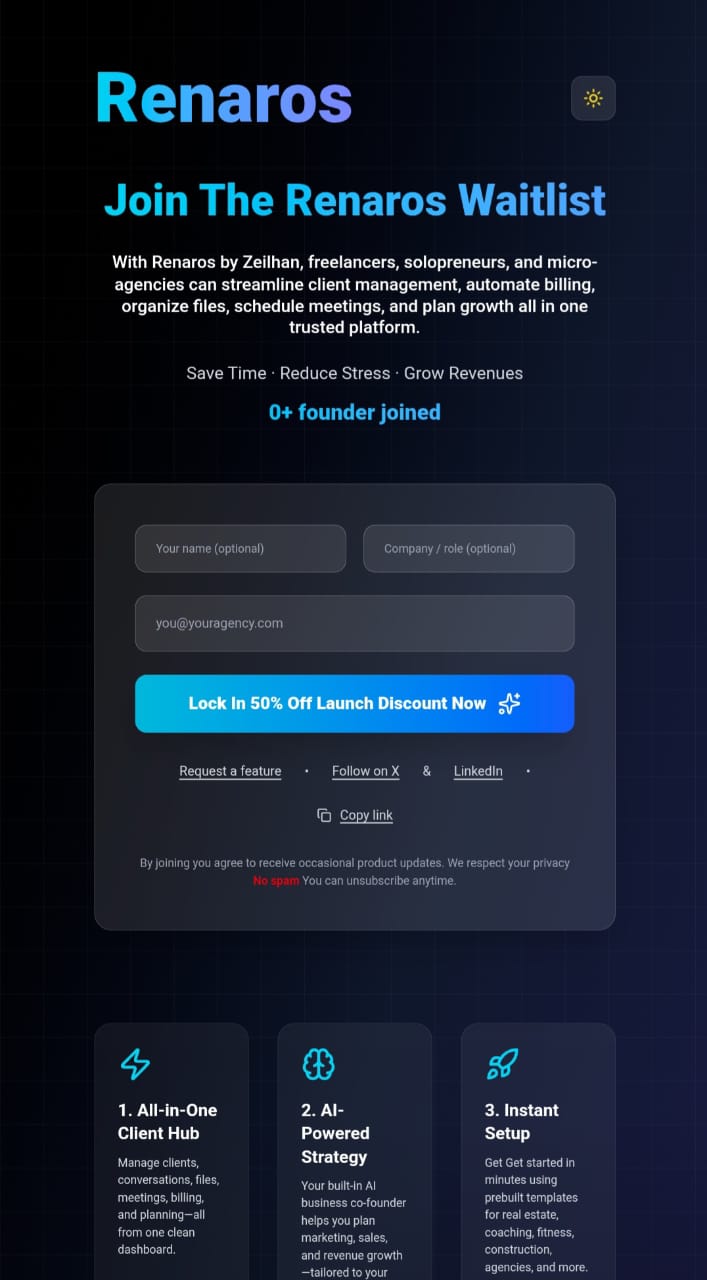
Renaros is an AI-powered SaaS platform designed to help small businesses and freelancers operate, manage, and grow through a single, secure system.
The platform is built with a long-term product mindset, prioritizing real workflows, scalable architecture, and trust over surface-level AI features.
Renaros is in active development and is being built in public, with continuous iteration informed by real implementation challenges rather than hypothetical use cases.
The product is positioned as an operating layer rather than a collection of disconnected tools, giving users clarity into what the system does, how automation works, and where AI is applied.
Problem
Small businesses and freelancers are forced to stitch together fragmented tools to handle planning, execution, operations, and decision-making.
Most AI products promise automation but fail to integrate cleanly into real workflows.
They often act as opaque black boxes, creating hesitation, misuse, or abandonment once users encounter edge cases, security concerns, or loss of control.
The result is low adoption, poor retention, and AI features that feel impressive in demos but unreliable in production environments.
Solution
Renaros was designed to balance automation with control.
Instead of hiding system behavior, the platform emphasizes visibility, predictability, and user intent.
Users can see what AI will do before it acts, understand how data is used, and decide when automation is appropriate.
The platform uses a freemium model to maximize adoption.
The free tier introduces users to the core system with usage caps, limited automation, and full visibility into AI behavior.
Paid tiers unlock advanced automation, higher usage limits, and expanded capabilities, targeting power users and growing teams who already trust the system.
My Role
I am the Founder, Product Owner, and Lead Engineer. I own the full product lifecycle, including vision, positioning, architecture, design, development, and go-to-market strategy.
This includes defining the product narrative, designing the data model and permission system, building the frontend experience, integrating AI capabilities, and planning monetization and growth.
Because I am also the primary builder, product decisions are grounded in real engineering constraints and real implementation friction rather than assumptions.
Product and Engineering Approach
Renaros is developed continuously, with product discovery happening through implementation rather than speculation.
Building the system exposed critical edge cases around permissions, data boundaries, and automation safety, leading to several backend redesigns that strengthened system integrity.
Security and correctness are treated as non-negotiable foundations.
The platform uses a multi-tenant architecture with strict role-based access control and row-level security, ensuring that users only see and act on what they are permitted to access.
This approach supports future expansion into team workflows, automation at scale, and enterprise-grade features without rework.
Technical Foundation
The frontend is built with React, TypeScript, and TailwindCSS, focusing on clarity, accessibility, and composability.
The backend is powered by Supabase, using structured schema design, authentication, and row-level security to enforce data boundaries at the database level.
Event logging, analytics hooks, and permission-aware services are built into the system to support product insights and future automation.
Continuous integration and deployment allow the platform to evolve quickly while maintaining stability.
Product Marketing and Positioning
Renaros is positioned as a transparent AI operating platform rather than a black-box assistant.
Messaging emphasizes trust, control, and real-world usability.
Instead of promising replacement of human decision-making, the product frames AI as an assistant that enhances clarity and execution.
The platform is marketed toward small business owners, freelancers, technical founders, and product-minded operators who value systems that scale with them rather than tools they will outgrow.
Monetization and Go-To-Market Strategy
The go-to-market strategy prioritizes adoption before monetization.
The free tier removes friction, builds trust, and demonstrates value through real usage.
Paid tiers are designed around value delivered rather than feature gating alone, unlocking automation depth and scale once users are confident in the system.
This approach aligns pricing with outcomes and positions Renaros for sustainable, product-led growth.
How I Think
Renaros reflects my broader product philosophy.
Adoption matters more than early revenue.
Trust must come before automation.
Visibility beats opacity.
AI should assist decisions, not replace responsibility.
Systems should earn the right to automate by proving reliability first.
Current Status and Path Forward
Renaros is live in active development, with plans to expand automation capabilities, refine onboarding, and deepen workflow support for growing teams.
The architecture is intentionally designed to support long-term scale, advanced AI features, and additional product surfaces without compromising security or clarity.